ON THE RECORD - PAUL WALKER
On The Record: Paul Walker on Local Radio, Community and the Reality of Keeping It Going
By Johnny Caudle | Caudle Media | October 5, 2026
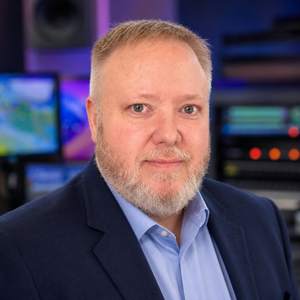
Paul Walker has wanted to work in radio for about as long as he can remember.
Growing up in Connecticut, he remembers his parents listening to Big D103 in Hartford. By the time he was 9 or 10, he wasn't just hearing the music anymore. He was paying attention to the people between the songs, the contests, the energy and even the mystery of how that signal somehow traveled through the air and came out of his radio.
“The magic of how the signal got to me fascinated the you know what outta me,” Walker said.
Like a lot of future radio people, he became the kid who called the station. A lot.
“I was the typical kid who called and pestered the local DJs with requests, with questions,” he said. “Most of them were so nice and patient with a punk kid who often didn't deserve it.”
That patience mattered. What started as a childhood fascination eventually became a career that's now lasted 23 years.
Today, Walker is News Director at Wolf Creek Broadcasting in Laramie, Wyoming, but his job goes well beyond delivering the news. He's an interviewer, an on-air personality and one of the people responsible for keeping local listeners informed and entertained. His career has also taken him to some very different places, including several years at KSKO in the remote Alaska community of McGrath.
Before writing this story, I spent some time listening to Walker's work. He's a straightforward interviewer who comes prepared, asks direct questions and then gives people room to answer. He listens closely enough to know when a follow-up is needed and keeps the conversation moving without making himself the center of it. There's nothing flashy about the approach, and that seems to be the point. His focus stays on the guest, the information and the people listening.
At 42, Walker is more than two decades into the career he started dreaming about as a kid.
“The fact I'm a fat kid living a dream,” he joked when I asked what has kept him in radio all these years. “You could go back to my fourth and fifth grade teachers, tell them what I'm doing with my life and they'd be like, ‘Yup, that's Paul. Not surprised at all.’”
That doesn't mean Walker looks at the radio business through rose-colored glasses. He knows the industry has problems. He also knows he's been fortunate to work at stations that gave him the freedom to figure out the kind of broadcaster he wanted to be.
And what he wants to do isn't particularly complicated.
“I don't focus on music or celebrity stuff,” Walker said. “I focus on local, laughs and food.”
If somebody enjoys a song he played, laughs at something he said or gets information that helps them stay informed, healthy or safe, he considers that a good day.
“Not many people at 42 can say they're doing as an adult what they dreamed of doing as a kid,” he said. “So I'm eternally grateful.”
That gratitude carries over into the way Walker thinks about community service. He believes a local radio station has a kind of power that can be used for good, especially when the people running it have the freedom to respond to what their community needs.
It's easy to forget there's a real person on the other side of the speaker. To Walker, that human connection is a big part of why local radio still works.
“We are just like them,” he said of listeners. “We are your next-door neighbor, and in many cases, we live right down the road from you. What affects you affects us.”
His career has taken him through music, entertainment, news and public radio, and from communities of around 30,000 people to one in Alaska with fewer than 300. Those experiences have taught him that there isn't one formula for serving an audience.
“What I do on a public radio station in a community of 275 people isn't what I'd do for an AC variety, CHR, country or rock audience in a county of 30,000,” Walker said.
His point is simple: every station and every community is different. What works in one place may make no sense in another. Serving listeners starts with understanding who they are and what they need from their local station.
The format may change. The size of the town may change. But Walker believes the basic responsibility doesn't.
“Radio still has a responsibility to serve and connect with the audience because people still turn to us at some level.”
For Walker, a lot of that relationship comes down to one word: trust.
Whether he was working in remote Alaska or broadcasting in Wyoming, Walker says he's tried to hold himself to the same standards when talking about news, emergencies and events affecting the people listening.
“When you bring the familiarity of local information and people learn they can trust you, that relationship forms,” he said. “They return often because they know they can find what they need from you, and they can trust what they get from you.”
He describes local radio as “a calm port in the storm.”
That phrase carries some weight when you consider the things Walker has had to cover. He's delivered tornado warnings. He's reported during telecommunications outages that put people's safety at risk. He's covered a town while it was flooding. He's also had the difficult job of telling listeners that someone in their community had died.
Those aren't moments when a broadcaster can simply go through the motions.
“Radio is inherently a more intimate and personal form of media than other modes of media,” Walker said. “I hate bad or sad news as much as the next person, but when people know they can turn to you for calm in the storm, they will.”
He thinks the human voice itself still matters, especially at a time when so much of our communication comes through texts, apps and social media posts.
“Voices can convey so much more than text,” he said. “Calm, trust and authority.”
Ask Walker what radio can still do better than podcasts, streaming services and all the other choices competing for people's attention, and he doesn't hesitate.
“LOCAL, LOCAL, LOCAL.”
“No one can drill down as local as a local radio station,” he said. “Especially in the moment of need, whatever that need is. We can pivot near instantaneously and meet the ever-changing needs of listeners.”
But believing in local radio and figuring out how to pay for it are two very different things.
That's where Walker's view of the business gets more complicated.
“Radio is hurting in a lot of places,” he said. “I realize I'm lucky to work where I work and get to do what I do.”
Working in small-market radio has shown him that there isn't always an easy fix when a station is struggling. A new format doesn't automatically create more advertising dollars. Neither does a new owner.
“Sometimes a format change isn't the answer. Sometimes a new owner isn't the answer,” Walker said. “The revenue just isn't there no matter what you do. You can be doing ALL the right things and then some and still not have revenue where you want it to be.”
Local businesses are facing their own financial pressures, and Walker says stations are also competing with the belief among some business owners that posting on social media is enough advertising.
He's even skeptical of one of the explanations often given for radio's problems today: the Telecommunications Act of 1996 and the consolidation that followed.
“I contend that even if the Telecom Act of '96 hadn't happened, we'd still be where we are, just maybe a couple years later,” he said.
That's Walker's view after more than two decades working in the business, and it reflects a larger point he keeps coming back to: there isn't one simple explanation for what has happened to radio, and there isn't one simple solution.
He's also heard the suggestion that stations should simply charge advertisers more. From his experience, that's easier said than done.
“Ever tried to do that to a client?” he said. “They will pull their money from you.”
Then there's the listener side of the equation.
“Radio finds itself between a rock and a hard place,” Walker said. “People want local, but then the commercials needed to pay for it get to be too much, they complain about that.”
It's an uncomfortable reality. Live personalities cost money. Local news costs money. Equipment breaks. Transmitters need maintenance. Stations have regulatory obligations. There are bills and expenses the average person listening in the car will never see.
Walker sees that side of the business every day.
“I work for a group of four signals where it's me, the owner, two salespeople, a traffic person and one remote voice tracker,” he said. “Our to-do list of things to fix, things to improve, legalities to deal with, expenses... never ends.”
That's the part of small-town radio that doesn't make it into the station promo.
There may be only a handful of people behind several signals, but listeners still expect the station to be there every day. They expect the music to play. They expect someone to tell them what's happening. And when the weather turns dangerous or something goes wrong in town, they expect somebody on the other side of that radio to know about it.
For Walker, that's still worth doing.
When I asked what he hopes people remember about Paul Walker, the broadcaster and the person behind the microphone, he didn't talk about ratings, market size or career accomplishments.
He talked about whether listeners could tell he meant it.
“I have as much fun on air as it sounds like I'm having,” he said. “If it sounds like I love my job, I do. And when you hear me laugh at myself, poke fun at myself, say that I love ya... it's all true, all genuine, and I mean everything I say or do.”
Maybe that's the thread connecting the kid listening to Big D103 in Connecticut with the broadcaster working in Wyoming today. The technology has changed. The business has changed. The economics have certainly changed.
But somebody is still sitting on the other side of that speaker.
And Paul Walker still thinks that matters.
If you'd like to hear Paul for yourself, he hosts Community Connections at 8:05 a.m. Mountain Time on Hits 106. His local newscasts air weekdays around 7:05 a.m., 12:05 p.m. and 5:05 p.m. Mountain Time, give or take a few minutes. He's also on Hits 106 from 3 to 7 p.m. Mountain Time Monday through Saturday. Past Community Connections interviews and the station's live stream can be found at myhits106.com.