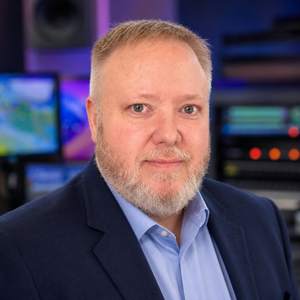
IN THEIR OWN WORDS - Phil Vavra
Few Charlotte broadcasters have successfully navigated as many formats as Phil Vavra. From Top 40 and Adult Contemporary to Country and now Classical Public Radio, his career has been defined by adaptability, curiosity, and a willingness to embrace change.
Today, Vavra can be heard hosting mornings on WDAV-FM 89.9, but his journey into broadcasting began long before he arrived in Charlotte.
“Like many in our field, I became enamored with radio as a kid,” Vavra said.
Growing up in the suburbs of New York City and Philadelphia, he got his first taste of the business while still in high school, working as a part-time music research assistant and van driver at Philadelphia’s Q102. College radio followed at the University of Pittsburgh, along with part-time work at 3WS and Y108.
After graduation, Vavra spent time in Seattle and Austin before making his way to Charlotte in 2000.
He hosted middays on the former Lite 102.9 for 12 years before moving into sales for a brief period. He later spent 11 years at K104.7, much of that time alongside Melany Myers. In January 2025, he began a new chapter at WDAV.
It wasn’t a move he ever expected to make.
“I never expected to work at WDAV,” he said.
While he admired the station, he also viewed public radio as unfamiliar territory.
“I didn’t know of many people who had made the transition from commercial broadcasting to public radio,” Vavra said.
At the time, WDAV was seeking a Multiplatform Producer. The position included on-air work, production, digital content creation, and podcasting responsibilities.
“It was a good match on paper,” he said.
Still, he quickly learned there was one area where his confidence may have exceeded his expertise.
“I had seen Amadeus twice, so I figured I knew everything I needed to know about the classical format,” Vavra joked. “I was wrong about that last part.”
The learning curve has become one of the most rewarding aspects of the job.
One misconception Vavra carried into public radio didn’t last very long.
“Years ago, I had been led to believe the public radio world didn’t think much of commercial radio,” he said. “However, that has not been the case at WDAV.”
Instead, he found a station that valued his commercial broadcasting background and encouraged him to contribute ideas based on his experience.
What surprised him most wasn’t the music. It was the audience.
“I was surprised to learn how much listener support goes into sustaining a radio station like WDAV,” he said.
Unlike commercial stations that rely heavily on advertising revenue, WDAV’s financial support comes largely from listeners.
“Most of the operating budget comes from the people who tune in every day.”
That audience connection appears to be reflected in recent performance trends. WDAV has experienced notable month-to-month fluctuations in the Nielsen ratings, including a recent surge that marked one of its strongest showings since March 2022.
Vavra notes that such movement is not unusual in the PPM environment.
“Every station sees fluctuations, and there can be dramatic swings. We had them all the time at K104.7,” he said. “That’s life in the PPM era.”
He added that a mix of factors can influence performance at WDAV, including increased visibility through outdoor and transit advertising, community event engagement, and a growing digital and social media presence.
“Sometimes Nielsen sends a meter to a big fan,” he added with a laugh.
That relationship between station and audience extends well beyond fundraising campaigns.
“WDAV has an amazing relationship with its audience, which extends far beyond the Carolinas,” Vavra said.
He was also impressed by the amount of effort the station invests in community engagement.
“The amount of time, energy, creativity, and resources put into marketing and events also surprised me.”
Among those efforts are WDAV’s Small Batch Concert Series at Free Range Brewing and the Reel Music Film Series at Independent Picture House.
Working at Davidson College, which owns and operates WDAV, has also been a positive experience.
“It’s quite a different environment than commercial broadcasting,” he said. “The college deserves a lot of credit for seeing the value in WDAV as an effective form of outreach across the region and beyond.”
From an on-air perspective, hosting a classical music program requires a different level of preparation than most commercial radio formats.
“Before every shift, I spend a good bit of time researching the music, composers, and performers on my playlist,” Vavra said.
Even after more than a year at the station, he knows there will always be more to learn.
“While I have learned a lot over the past year, I’m working with 500 years of music. I’ll never stop learning something new here.”
The learning process included mastering pronunciations and understanding the nuances of the format.
“For the first six weeks I worked at WDAV, our content director, Rachel Stewart, had me recording practice shifts in a production studio,” he said. “I probably could have used a couple more weeks of that before going on the air.”
Although he still occasionally stumbles over a composer’s name, he says he’s come a long way since those early days.
Having worked extensively in both commercial and public radio, Vavra sees similarities between audiences but also some notable differences.
“Country radio audiences always struck me as being very loyal to their favorite stations and personalities,” he said. “Classical radio listeners might be even more so.”
Part of that connection comes from the music itself.
“They may have grown up listening to it with their parents like I did. Maybe they learned to play some of these pieces in their school orchestra. Or it could simply be the feeling they get from hearing something as powerful as Beethoven’s ‘Ode to Joy’ or Handel’s Messiah.”
But public radio listeners often have an even deeper relationship with the station.
“Many public radio fans are literally invested in their favorite station,” he said. “They’re not just listeners; they’re financial supporters, members, and volunteers.”
That connection sometimes takes broadcasters far beyond the studio.
“We even travel together,” Vavra said.
He recently spent ten days touring Naples and Italy’s Amalfi Coast with a group of WDAV listeners.
“It was an unforgettable experience.”
Like many broadcasters, Vavra believes radio faces significant challenges in the years ahead.
“Reaching and being relevant to the next generation of media users and sponsors is a challenge for both commercial and non-comm radio stations,” he said.
He believes stations must continue finding new ways to market themselves and connect with audiences.
“Commercial stations need advertisers to find renewed faith in the power of radio.”
Public media faces its own set of obstacles, including adapting to changes in federal funding and support.
“None of these challenges are impossible to overcome,” he said. “But the job is a lot harder than it used to be.”
Earlier this year, Vavra stepped into mornings at WDAV, succeeding longtime morning host Mike McKay.
“When I was approached about moving to mornings after only a year with the station, I suggested someone else might be a better fit,” he said. “Mike McKay is a tough act to follow.”
Ultimately, he accepted the challenge and has enjoyed the role.
“I always liked being on the air at that time.”
He also credits the station’s team for making the transition easier.
“I still have plenty of opportunities to work with this incredibly talented and supportive group of professionals every day.”
As for the future, Vavra sees uncertainty, but he also sees opportunity.
“While it may feel like there’s a bit of uncertainty for public radio and WDAV, there’s also a great deal of opportunity for evolution and growth.”
More importantly, he doesn’t fear change.
“We could be entering a very exciting time,” he said. “More change is inevitable, but I’ve lived long enough to know that’s not something to fear.”
Phil Vavra
Morning Host and Multiplatform Producer
WDAV-FM 89.9 Classical Public Radio
phvavra@wdav.org